Welcome

from Jacqui and me to this record of our experiences as new beekeepers in The Marches.


Search This Blog

Tuesday, 1 June 2010

Dingbat?


I may be one. Monday was bright following the rain of Sunday so I went to check the stores in hives 2 [the original swarm] and 3 [the second swarm]. Top box on 2 has fresh foundation that has still not been drawn out into comb. Next Box down has good stores but nasty surprise in third box just above the queen excluder. As pic shows there was a sealed queen cell on one side and there were three more on the other side. How did eggs [brood] get laid above the queen excluder? Either queen trapped above the excluder or I have workers laying - a bad sign. Having to make a decision there and then I decided to destroy all the Q cells because they looked small. Then checked the box below the queen excluder. No Queen cells, lots of bees, no brood. Given that the old queen who took the swarm should have been laying in the available comb this not good. Brought the box that had contained the Q cells down below the Queen Xcluder. Didn't see her there but lots of bees and didn't want to disturb them any more.
With hindsight I think I should have left one Queen cell and given them the chance to raise her. May finish up with a queenless colony through my own stupidity but never mind. I can either merge them with a successful colony later or give them a frame of brood so they may raise their own queen.

Monday, 24 May 2010

Followers


The blogger welcomes followers but the beekeeper does not. If the bees are in a bad mood the beekeeper upon leaving the apiary may be followed by angry bees, "followers", for some distance before they return to the hive. One of our hives has no queen at present whilst the workers rear a new one. Consequently the workers are irritable with anything that interferes with their work and we have followers. Sadly as a blogger I still have no followers!!
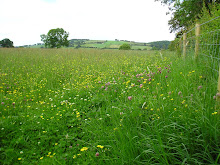
Jacqui took this pic that for me sums up what it is like to keep bees in the Marches.

Wednesday, 19 May 2010

Oops!!


I think I must have missed a sealed queen cell when examining Hive 1 last Sunday. Out in the garden yesterday afternoon I heard the ominous roar of multi bees and soon spotted a swarm on the other side of our sycamore hedge. Once again out with all the kit and eventually as above pic shows I managed to get the bees to march into a super full of frames. I have bedded them down overnight in the apiary with their entrance plugged with grass. I now need to sort out a fresh brood box to provide them with a long term home. This swarm must have a virgin queen so I believe it should correctly be called a caste. It is a tall order to get the queen mated and laying but we and the workers must be optimistic.
Swarming score now bees 2, beekeeper 0.

Tuesday, 18 May 2010

The battle for survival


So, this season's fight for survival has begun. Following the swarm last weekend two separate battles are underway. The original colony [Hive 1] is now left without a queen but they do have brood that will be hatching out over the next couple of weeks. They must rear a new queen in order to survive.
The swarm colony [Hive 2] have a queen but no brood so they must build comb rapidly to enable her to lay eggs. Once she starts the first new bees will not emerge for a further 25 days. In the meantime the old tired bees will be dying off so reducing colony numbers. Its a race against time.

Monday, 17 May 2010

A swarm and a sting


Swarms and stings are to beekeepers what death and taxes are to all of us - inevitable. One of the main skills of beekeeping is swarm prevention, or at least control. Having boned up on the procedure I was fully prepared to carry out our first artificial swarm [a method of preventing loss of a swarm] on Sunday, but the bees decided to leave on Saturday!! Jacqui was outside with Ruffle when she heard the unmistakable roar from the end of the garden. Fortunately the bees were gathering in the sycamore hedge only a short distance from the hive. With the butterflies in my stomach similarly swarming I put on the kit, lit our smoker and gathered some boxes.
Earlier in the week I had set out a spare hive on a stand so the plan was to persuade the swarm to set up home there. I managed to shake the bees into my boxes, it took several goes, and then upended the boxes on to a white sheet. Pausing only to extract my first sting from my left thumb, I placed a wooden board up against the landing board on the new hive and covered it with a white sheet. Then I carried over the boxes wrapped in their sheet and shook them on to the board. After a nervous few moments for me the bees turned uphill and started to march into the hive. It is a truly amazing sight. I used a pheasant feather to redirect some that missed the entrance and were marching straight on up the front of the hive. At no time did I spot the old queen but I think she must have been there otherwise the bees would have marched straight out again. The air was full of flying bees all this time but gradually they settled down.
A swarm usually takes about one third to one half of the bees leaving the non-flyers, some flyers and all the brood in the original hive. In the evening I set about moving the old hive to one side and placed the swarm hive in the original position. This should mean that next day flying bees return to the swarm hive strenghtening it.
Next day, Sunday, I went through the old hive removing all the capped queen cells [a couple are shown pictured above you can just see the larva though the broken end], leaving uncapped ones. In a weeks time I shall go in to that hive again and remove all but one of the queen cells. Hopefully we shall finish up with a new colony with a laying queen in about three weeks from then. As to the swarm that will lose numbers until the bees have created new cells and the old queen has started laying again. What we need now is warm weather and a strong nectar flow.
As to that sting, I was wearing "Marigold" rubber gloves. They cannot prevent the sting but they do stop it penetrating too deep and they make it easy quickly to remove the venom sack. All in all not as bad as I had expected!!
As to my beekeeping skills and swarming the present score is bees 1 beekeeper 0.

Friday, 30 April 2010

Ooops, a sting


Reading back in this blog I realise that it has become a bit of an "anorack's diary" so its time to lighten up.
Following a rush of blood to the head we now have a new Labradoodle puppy. On Wednesday she was out by our pond with Jacqui. Unfortunately so were a good number of our honey production team collecting water needed in the hive. Ruffle being an inquisitive 9 week old, was fascinated by the buzzing sound in the shallows and headed straight in to check it out. Bees' worst enemy are bears that tend to be big, dark, and furry so a worker is programmed to defend the colony by burrowing into the fur to sting. Seeing a worker on top of Ruffle's head Jacqui selflessly grabbed the bee with her hand and removed it but of course got stung in the process. Fortunately she knew to scrape the sting away with her fingernail so that the pulsing sack of venom was quickly removed and the pain quickly subsided. Not everyone is aware that, despite being torn from the dying bee's body, muscles attached to the sting will continue to pulse for up to 20 mins driving yet more venom into the victim. Hence quick removal is a good idea!
Only a wife and a bee were hurt in the making of this story, Ruffle was entirely unharmed and, it has to be said, unconcerned.

Tuesday, 27 April 2010

The season starts


Thanks to warm days, blossom/pollen on the Bullace Birch and Alder, the bees have been very busy. The hive over-wintered with a super on top of a brood box, no queen excluder. On Sunday 11th April I examined the hive. Lots of bees present. The super contained plenty of honey stores and there was some capped brood at the bottom of the middle frames. Between the super and brood box a small quantity of brace comb had been built with some capped drone cells. The main brood box was well filled with brood both capped and uncapped. Decided to move the super to the bottom. Placed the brood box on top, then queen excluder with a super of drawn comb over that. The object is to give space for the bees to bring in honey without limiting the brood space for the laying queen. Hopefully this will discourage early swarming. The pic shows one of the super frames with capped and uncapped honey. Second pic shows some drone larvae that were exposed and removed.
On Sunday 18th I carried out the first full inspection of the year examining all frames. Didn't spot the queen but not surprising as there were a lot of bees in residence. The new super on top is filing nicely with honey. All seemed to be well with the brood so left well alone.
Inspection on 26th April revealed one play cell but otherwise nothing of note. Honey stores gradually improving. I shall have to keep an eye on the play cell in case it is built into a queen cell.